
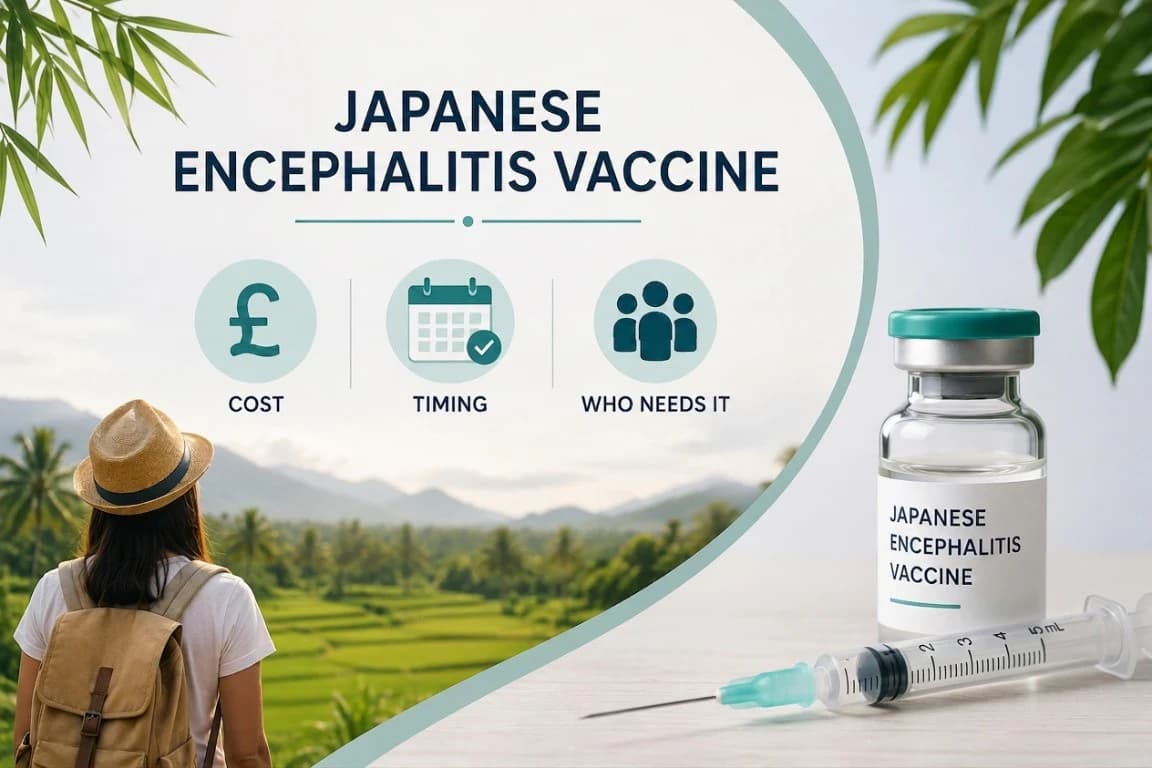
Japanese encephalitis is a rare but potentially severe mosquito-borne infection found mainly in parts of Asia and the Western Pacific. Most short urban trips carry a very low risk, but vaccination may be appropriate for longer stays, rural travel or activities that create substantial evening and night-time mosquito exposure.
This guide helps travellers judge which itinerary details make the infection more relevant. For IXIARO prices, eligibility and standard or rapid schedules, see the Japanese encephalitis vaccine service page.
Allow enough time to complete the course. IXIARO requires two doses, and primary vaccination should be completed at least one week before potential exposure.
What is Japanese encephalitis?
Japanese encephalitis is caused by a flavivirus transmitted by infected mosquitoes. Transmission is associated particularly with rural agricultural areas, rice fields and pig farming, although the exact pattern varies by country and season.
Most infections cause no symptoms. When encephalitis develops, illness can be severe and may cause seizures, confusion, neurological disability or death. There is no specific antiviral treatment.
Who should consider Japanese encephalitis vaccination?
Vaccination is more likely to be considered for travellers who:
- Will spend a month or longer in a risk area during the transmission season.
- Will make repeated visits or live in an endemic area.
- Will spend significant time in rural, agricultural or rice-growing areas.
- Plan camping, cycling, trekking or extensive evening outdoor activity.
- Have an uncertain itinerary or accommodation without effective mosquito protection.
A shorter trip can still create a meaningful risk when exposure is intensive. Conversely, a brief trip confined to major urban centres may not justify vaccination. Check each destination using TravelHealthPro.
Our Japanese encephalitis vaccine
IXIARO is the Japanese encephalitis vaccine used in the UK. A clinician will confirm whether it is justified and select the licensed schedule appropriate to age, departure date and health.
IXIARO vaccination schedules
Standard courseAll licensed age groups.

Rapid courseAdults aged 18 to 65 only.
The standard course uses days 0 and 28. The licensed rapid schedule uses days 0 and 7 only for adults aged 18 to 65. With either schedule, the second dose should be completed at least one week before potential exposure.
A booster is considered within the second year before further exposure. The exact timing depends on age, continuing risk and previous schedule. See the current IXIARO product information.
How long does IXIARO protection last?
The two-dose primary course provides protection for the immediate period of risk, but it should not be treated as lifelong vaccination. People who are likely to be exposed again should receive a first booster within 12 to 24 months of the primary course, before the next exposure.
After that first booster, current IXIARO product information recommends a further booster 10 years later if exposure will continue or recur. Protection is less certain in adults over 65, so an earlier booster may be considered following individual assessment.
What if I am travelling soon?
Adults aged 18 to 65 may be eligible for the licensed rapid schedule. Children, adolescents and adults over 65 use the standard licensed schedule, although specialist UK guidance may occasionally support an off-label approach when there is genuinely insufficient time.
An accelerated schedule does not remove the need for an individual risk-benefit assessment. If vaccination cannot be completed, mosquito-bite precautions become especially important.
Mosquito precautions remain essential
IXIARO does not protect against dengue, malaria, chikungunya or other mosquito-borne infections. Travellers should use an effective insect repellent, wear covering clothing, use screened or air-conditioned accommodation and sleep under an insecticide-treated net when appropriate.
The mosquitoes associated with Japanese encephalitis often feed from dusk through the night, so protection should continue during evening and sleeping hours.
Side effects and suitability
Common effects include injection-site pain or tenderness, headache, muscle aches and tiredness. Children may also develop fever or irritability. Most reactions are short-lived.
Previous severe vaccine reactions, pregnancy, breastfeeding, acute illness, immune conditions, bleeding disorders, age and medicines must be reviewed. Vaccination does not guarantee protection in every person.
Is IXIARO available through the NHS?
Japanese encephalitis vaccination for ordinary travel is generally provided privately. Read our Southampton comparison of NHS and private travel vaccinations.
Book Japanese encephalitis vaccination in Southampton
Southampton Travel Vaccines’s approach
Complete our online travel-health assessment with every destination, travel date, accommodation type and planned activity. Rural side trips and evening outdoor exposure can materially change the recommendation.
A clinician will assess whether IXIARO is appropriate and which schedule can be completed safely. Vaccination is provided face to face at our Southampton travel clinic in Bitterne.
Official sources and further reading
Continue exploring
Related reading
Who Should Consider Hepatitis B Vaccination Before Travel?
Understand how medical care, sexual contact, tattoos, work and longer stays can affect hepatitis B risk while travelling.
Read article
Do I Need Hepatitis A Vaccination for Travel?
Understand which destinations and travel styles increase hepatitis A risk, when to seek advice and why food and water precautions still matter.
Read article
Do I Need Typhoid Vaccination for My Trip?
Understand how destination, sanitation, accommodation and eating with local communities affect typhoid risk during travel.
Read article