
Southampton Travel Vaccines’s approach
We check your destination, transit points, dates and health together. A Yellow Fever certificate decision should reflect the complete itinerary, not just the country printed on the final ticket.
What is Yellow Fever?
Yellow Fever is a potentially serious viral infection transmitted by infected mosquitoes. It occurs in parts of sub-Saharan Africa and tropical South America. It does not spread directly from one person to another through ordinary contact.
Early illness can cause fever, headache, muscle pain, nausea and weakness. A smaller proportion of people develop severe disease involving jaundice, bleeding, shock and organ failure. There is no specific antiviral treatment, which is why vaccination and mosquito bite prevention are important when exposure risk is significant.
What is a Yellow Fever certificate?
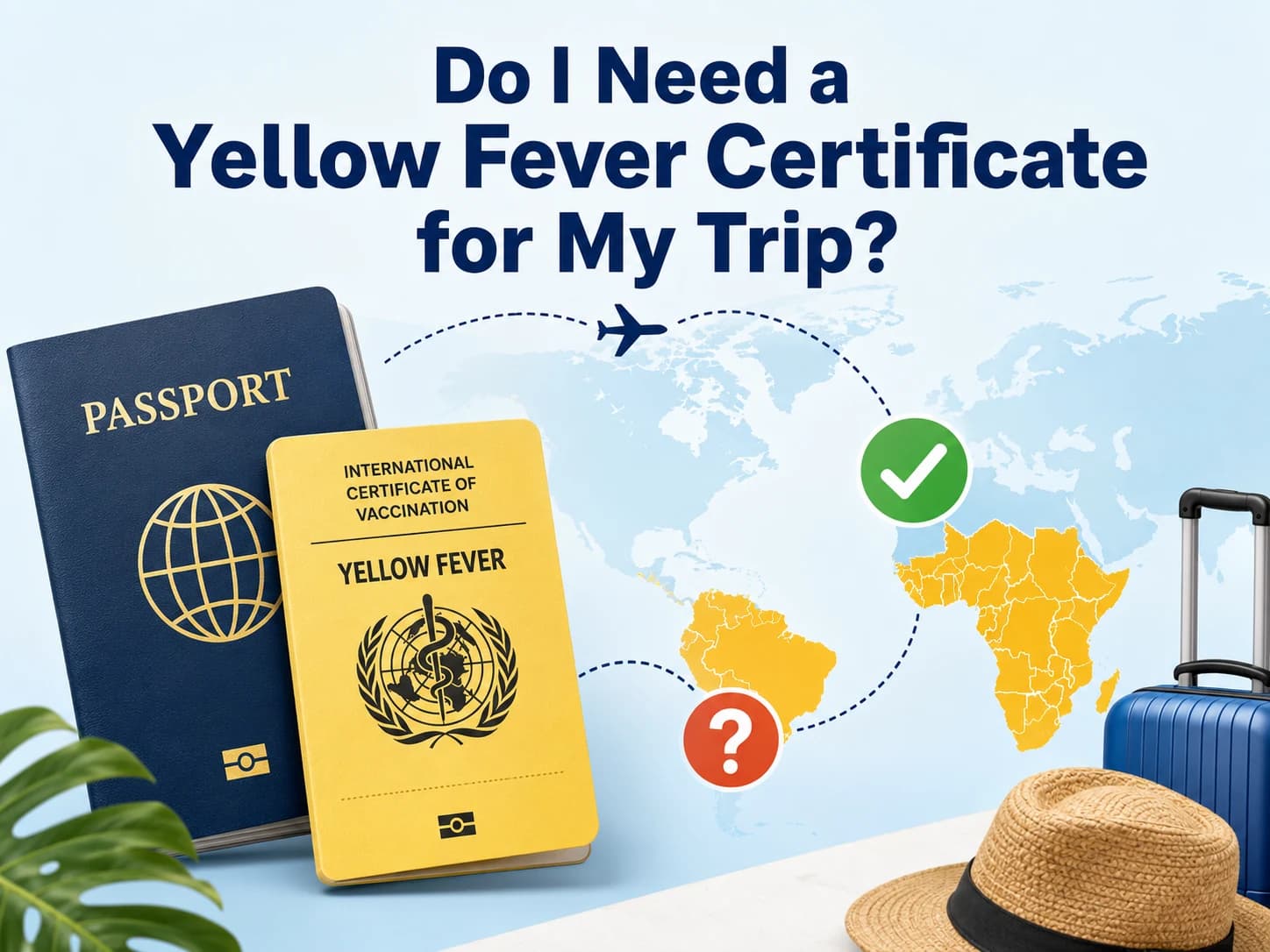
The International Certificate of Vaccination or Prophylaxis, often called an ICVP or Yellow Fever certificate, is the internationally recognised paper record of vaccination. It must be completed correctly by an authorised Yellow Fever vaccination centre.
Yellow Fever is the disease specifically designated under the International Health Regulations for which countries may require proof of vaccination as a condition of entry.
Protection and entry requirements are different
You may be advised to have the vaccine because Yellow Fever is a health risk at your destination. Separately, a country may require a certificate to reduce the risk of the virus being imported. Either reason may apply, both may apply or neither may apply.
Ask two separate questions: do I need protection from Yellow Fever, and does any country on my route require proof of vaccination?
When might a certificate be required?
A country may require proof from every arriving traveller, but requirements more commonly depend on recent travel through a country where Yellow Fever transmission is a risk. Rules can also vary by age.
The requirement is set by the destination country and can change. Check the NaTHNaC TravelHealthPro country list for current UK recommendations and entry requirements, then check again close to departure. Look separately at the Yellow Fever vaccine recommendation and the certificate requirement because they answer different questions.
Why airport transit can change the answer
A transit can count even when it is not your final destination. Some entry rules refer to travellers who have passed through an airport in a Yellow Fever risk country, sometimes using a time threshold or distinguishing between remaining airside and leaving the airport.
A threshold of more than 12 hours is used in some country requirements, but it is not a universal rule. Another destination may apply a different duration, count any transit, or treat leaving the airport differently. Check the TravelHealthPro page for the country you enter after the transit, not only the country where the connection occurs.
Give the clinician every flight connection, the expected transit duration and whether you plan to pass immigration. Return journeys and separate tickets should also be included.
Southampton Travel Vaccines’s approach
We assess the route in both directions. If an entry rule depends on transit duration or recent presence in another country, we explain which part of your itinerary triggers the concern and what documentation may be needed.
What happens without a valid certificate?
If proof is required and you arrive without a valid ICVP, the response depends on local rules. This can disrupt onward travel, and it does not mean that immediate border vaccination will satisfy the original requirement.
- Delayed or refused entry at the border
- Quarantine on arrival
- Vaccination administered at the border itself
- Official monitoring for symptoms during your stay
A certificate for a first dose is not valid until 10 days after vaccination. An incomplete, altered or incorrectly completed certificate may also be rejected. Airlines may check documents before boarding, but passing an airline check does not guarantee acceptance by border authorities.
When does the certificate become valid?
For a first Yellow Fever vaccination, the certificate normally becomes valid 10 days after the vaccine is administered. This period matters when proof is required for entry.
Book early enough for assessment as well as the 10 day validity period. Vaccination may not be suitable for everyone because Yellow Fever vaccine is a live vaccine and requires an individual risk and benefit assessment.
How long does a Yellow Fever certificate last?
Under the International Health Regulations, one documented full dose normally provides lifelong protection and a correctly completed certificate is valid for the lifetime of the vaccinated person. This lifetime rule applies to certificates issued before and after the change took effect in July 2016.
Countries cannot routinely demand a booster as an entry condition simply because an older certificate says it expires after 10 years.
Keep the original certificate safe because replacing evidence later may require verification of the original vaccination record.
Do some travellers still need another dose?
Lifetime certificate validity does not mean that every clinical situation is identical. A specialist may occasionally recommend revaccination following an individual assessment, for example in certain circumstances involving immune status or continuing exposure.
This is a clinical protection decision, not a routine renewal of the certificate. Do not arrange a booster solely because the original dose was more than 10 years ago without first having the record and itinerary reviewed.
What if your certificate is lost or incorrect?
Contact the centre that administered the vaccine. A replacement can only be completed when the vaccination details can be verified. The name, date of birth, vaccine date, product, batch information, clinician signature and official centre stamp must be recorded correctly.
Do not alter the certificate yourself. Carry the original paper document when travelling if it is required, even if you also keep a photograph for your records.
What if you cannot have the vaccine?
If vaccination is contraindicated, an authorised centre may consider issuing a medical waiver after assessment. This does not provide immunity from Yellow Fever and does not guarantee entry. Acceptance is determined by the border authorities of the destination country.
The clinician should discuss the infection risk, mosquito bite prevention, possible itinerary changes and the uncertainty around waiver acceptance. Contact the relevant embassy or consulate where entry consequences are unclear.
Who is usually eligible for Yellow Fever vaccination?
Yellow Fever vaccine is generally considered for travellers aged nine months or older who will enter a Yellow Fever risk area or need valid proof for entry. Suitability still depends on the individual balance between exposure risk, certificate requirement and vaccine risk.
Extra caution and an individual risk assessment are needed for:
- People aged 60 or over
- Infants aged six to eight months
- Pregnancy or breastfeeding an infant under nine months
- Some long-term inflammatory or immune conditions
Vaccination may still be considered in these circumstances when the travel risk is judged greater than the vaccine risk.
Who may be excluded from vaccination?
Yellow Fever is a live vaccine, so it is generally contraindicated for:
- Babies under six months
- People with significant immune suppression from illness or treatment
- Those with certain thymus disorders or previous thymus removal
- Anyone with a severe allergy to a vaccine component, or a severe reaction to a previous dose
This list is not a substitute for assessment. Medicine doses, immune conditions and previous reactions require clinical interpretation. If vaccination is unsuitable, the clinician can discuss a medical waiver, itinerary changes and strict mosquito bite avoidance.
What are YEL-AND and YEL-AVD?
Two rare but serious reaction types are why first-time vaccination always involves an individual risk assessment, especially for older adults.
- YEL-AND — vaccine-associated neurotropic disease. A rare reaction affecting the nervous system, with symptoms such as high fever, severe headache, confusion, weakness or other neurological features. Reported mainly after a first Yellow Fever vaccination.
- YEL-AVD — vaccine-associated viscerotropic disease. A very rare but potentially life-threatening reaction in which illness resembles severe Yellow Fever and affects multiple organs.
These events are rare, but their severity is why the vaccine should only be given when the likely benefit outweighs the risk. Seek urgent medical attention for severe or rapidly worsening illness after vaccination.
Why must you use a certified Yellow Fever centre?
Only a designated Yellow Fever Vaccination Centre can provide the vaccine and issue an official ICVP in the UK. Designation supports appropriate staff training, vaccine handling, clinical procedures, records and use of the official centre stamp.
You can verify a centre using the official NaTHNaC Yellow Fever Vaccination Centre search. Search by postcode or location rather than relying only on a clinic website stating that it offers travel vaccines.
Is Yellow Fever vaccination available on the NHS?
Yellow Fever vaccination for travel is a private service and is not provided free on the NHS. At Southampton Travel Vaccines, the current price is confirmed when you book. This includes the vaccination and official Yellow Fever certificate where vaccination is clinically appropriate.
Complete your assessment before attending
Southampton Travel Vaccines collects your outward and return itinerary, transit durations, health history, medicines, allergies and previous vaccination details through the online assessment. This lets the clinician check both the certificate requirement and vaccine suitability before the appointment.
Bring the original of any previous Yellow Fever certificate that could not be verified during the assessment. Do not delay seeking advice simply because an old record is missing.
Get assessed at a Southampton Yellow Fever centre
Southampton Travel Vaccines’s approach
Southampton Travel Vaccines provides Yellow Fever vaccination through our registered Yellow Fever vaccination centres in Southampton. Our current price is confirmed when you book, including the vaccination and official ICVP where clinically appropriate. We assess the complete itinerary and individual suitability before administration.
Read about our Yellow Fever vaccination service in Southampton or start your travel assessment.
Official sources
Continue exploring
Related reading
Who Should Consider Hepatitis B Vaccination Before Travel?
Understand how medical care, sexual contact, tattoos, work and longer stays can affect hepatitis B risk while travelling.
Read article
Is Japanese Encephalitis Vaccination Needed for My Trip?
Learn how destination, season, trip length, rural stays and evening outdoor exposure determine whether vaccination may be worth considering.
Read article
Do I Need Hepatitis A Vaccination for Travel?
Understand which destinations and travel styles increase hepatitis A risk, when to seek advice and why food and water precautions still matter.
Read article