
Southampton Travel Vaccines’s approach
We assess your complete itinerary, previous vaccines, health and departure date before recommending a plan. If time is short, we prioritise the protection and documentation that can still make a meaningful difference.
When should you book travel vaccinations?
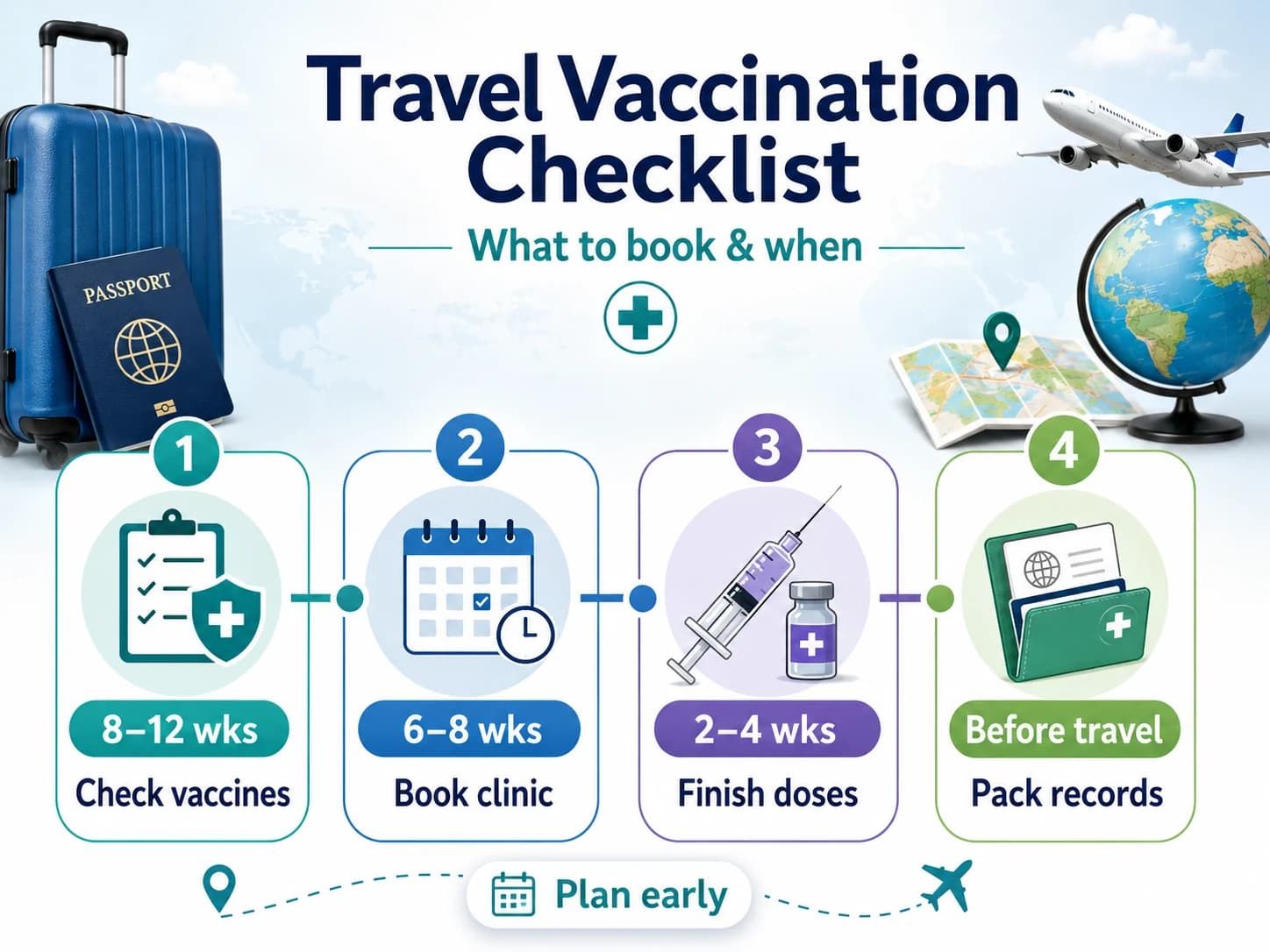
Try to arrange travel health advice at least four to six weeks before departure. This allows time to review your records, complete vaccines that need more than one dose and develop protection before exposure.
Book earlier for a long trip, several countries, remote travel, work or volunteering, pregnancy, immune suppression or a complex medical history. Some courses may begin months before departure.
Early is best, but late does not mean pointless. Where a vaccine is recommended and clinically suitable, receiving it late is generally better than travelling completely unvaccinated. Immunity is not immediate, but it may continue developing during your journey and provide protection for exposures later in the trip. You must still understand that protection may be incomplete during the first days after vaccination.
Travelling soon does not mean there is nothing to do. A late assessment can still identify useful vaccines, malaria prevention, bite precautions and entry documents.
Your numbered travel vaccination checklist
- Write down the complete route. Include every destination, airport transit, land crossing and the return journey.
- Check each country on TravelHealthPro. NaTHNaC’s TravelHealthPro country pages separate certificate requirements from vaccines recommended for your health.
- Review the route on our map. Select a country below to open its destination guide with vaccine, malaria and Yellow Fever information.
- Find your previous records. Check the NHS App, ask your GP practice and locate any original Yellow Fever certificate.
- Arrange an individual assessment. Recommendations depend on the dates, activities, accommodation, health and previous vaccinations, not only the country name.
- Book the earliest useful doses. Some vaccines need several appointments, while others can still offer worthwhile protection when given close to departure.
- Plan malaria prevention. Confirm whether tablets are advised, when to start them and how long to continue after leaving the risk area.
- Pack records and prevention supplies. Carry required original certificates and pack repellent, regular medicines and prescribed travel medicines.
Check the official TravelHealthPro country list, then use the interactive map below to explore the corresponding Southampton Travel Vaccines destination guide.
Check your destination on the map
No country is selected initially. Click your destination to view its vaccine recommendations, malaria information and Yellow Fever guidance. Always check transit countries separately.
Eight to twelve weeks before travel
- List every destination in order, including airport and land transits.
- Record departure and return dates, accommodation and planned activities.
- Check your NHS App, GP record and old travel certificates.
- Book a travel health assessment, especially for multi dose courses.
- Check passport, visa and destination entry requirements separately.
Do not choose vaccines from a country list alone. Risk may change within a country and according to rural travel, season, trip duration, contact with animals, access to medical care and the purpose of travel.
Four to six weeks before travel
This is the main booking window recommended by the NHS. At the appointment, the clinician can compare routine UK immunisations with destination specific risks and build a schedule around your available time.
Depending on the trip, the discussion may include hepatitis A, typhoid, tetanus, diphtheria and polio, hepatitis B, rabies, Japanese encephalitis, meningococcal ACWY, cholera or yellow fever. A recommendation is not the same as an entry requirement.
Southampton Travel Vaccines’s approach
Our Southampton travel clinic explains which measures are recommended for most travellers, which depend on your activities and which are legally required for the route. You can then make an informed decision without treating every possible vaccine as equally urgent.
How long do different travel vaccines need?
There is no single lead time for every vaccine. The examples below show why an early assessment helps, although product, age, health and previous doses can change the schedule.
- Yellow Fever: a first ICVP normally becomes valid 10 days after vaccination. If the destination requires proof, the vaccine should be given at least 10 days before arrival.
- Hepatitis A: ideally given before travel with time for an immune response. A late first dose may still be considered because protection develops after vaccination and can continue developing during the trip.
- Injectable typhoid: ideally given at least two weeks before potential exposure. Food and water precautions remain important because vaccination is not fully protective.
- Rabies: a pre exposure course may require doses on days 0, 7 and 21 or 28. An accelerated schedule may be considered when time is short, depending on the vaccine and traveller.
- Japanese encephalitis: the standard course uses doses on days 0 and 28. Adults aged 18 to 65 may be eligible for a days 0 and 7 accelerated course, with the course completed at least one week before exposure.
- Hepatitis B: standard courses take several months, although accelerated schedules are available in some circumstances. Later doses may still be needed after travel.
These are planning examples rather than personal schedules. A clinician should confirm the exact product, dose intervals and point at which protection is expected.
Two to four weeks before travel
Attend the earliest appointment available. There may still be time for single dose vaccines, later doses in an existing course or an accelerated schedule where one is clinically appropriate.
If malaria tablets are recommended, the start date varies by medicine. The clinician also needs enough information to check contraindications, interactions, trip duration and the tablets needed before, during and after exposure.
Less than two weeks before travel
Seek advice rather than assuming it is too late. Your plan may focus on vaccines that can still provide benefit, essential certificates, malaria prevention and practical ways to reduce exposure.
A first yellow fever certificate normally becomes valid ten days after vaccination. If your route requires a valid certificate and departure is closer than this, discuss the itinerary promptly with a registered yellow fever vaccination centre.
Arriving without valid proof where a certificate is required can cause delays, refusal of entry, quarantine or other action under the destination country’s rules. Vaccination at the border should never be relied upon. Check current official entry guidance and allow time for the certificate to become valid.
Complete your assessment before the appointment
Southampton Travel Vaccines collects the information needed for your travel health review through our online assessment before you attend. This includes your complete itinerary and transits, travel dates, accommodation, planned activities, medical history, current medicines, allergies and relevant information about pregnancy, breastfeeding or immune conditions.
You can also provide details of previous vaccinations and any Yellow Fever certificate. Completing the assessment accurately allows the clinician to review your route and prepare an individual recommendation before the appointment, leaving more time to clarify the plan, answer questions and administer agreed vaccines.
Southampton Travel Vaccines’s approach
Complete your travel assessment online before attending. At the appointment, bring any original Yellow Fever certificate and vaccination records that were not available when you completed the form. If a record is missing, do not delay the assessment; the clinician can explain what can be established and whether further evidence is needed.
Routine vaccines are part of the checklist
Travel planning is also an opportunity to check routine UK vaccinations. Being up to date with vaccines such as measles, mumps and rubella matters because infections can circulate internationally, including in popular destinations.
Your travel clinic may advise you to obtain certain routine vaccines through NHS services. Availability and eligibility can differ from privately supplied travel vaccines.
Which travel vaccines are free on the NHS?
When clinically indicated for travel, hepatitis A, typhoid, cholera and polio given as part of the combined tetanus, diphtheria and polio vaccine are available free through the NHS.
How the service is organised varies between GP practices. Some practices provide the full NHS travel vaccination service, while others have limited clinics or direct patients elsewhere. Their assessment forms, appointment capacity and notice periods also vary, and some ask for several weeks or even months of notice before departure.
Contact your GP practice early and ask what it currently provides. If it cannot see you in time, a private travel clinic can still assess the complete itinerary, but an NHS funded vaccine should not be assumed to be free when supplied privately.
Remember malaria and bite prevention
Vaccines are only one part of travel preparation. Some destinations require an individual malaria risk assessment. Where tablets are advised, the choice depends on the exact area, medical history, other medicines and duration of travel.
Atovaquone with proguanil and doxycycline are generally started one to two days before entering the malaria risk area. Other medicines start earlier: mefloquine is normally started sufficiently in advance to assess tolerability. The course must also continue for the required period after leaving the risk area, which differs by medicine.
Use effective insect repellent, suitable clothing and screened or air conditioned accommodation where mosquito borne infections occur. Read our bite avoidance guide for travellers for practical steps.
Can travel vaccines be given together?
Many travel vaccines can be administered during the same visit at different injection sites. This can be helpful when departure is close.
Some live vaccines need particular timing when they are not given on the same day. Your clinician should account for recent vaccines as well as those planned elsewhere, so share the date and name of every recent vaccination.
Your final week checklist
- Carry required original certificates with your travel documents.
- Check that names and passport details are correct where applicable.
- Pack sufficient regular medicine and any prescribed travel medicine.
- Confirm when malaria tablets start and finish.
- Pack repellent, sunscreen and a suitable travel health kit.
- Review current destination and entry advice before departure.
Book a travel health assessment in Southampton
Southampton Travel Vaccines’s approach
Southampton Travel Vaccines provides individual travel health assessments, vaccinations and malaria advice from our Southampton clinic. We can review a single destination or a complex route and organise the available appointments around your departure date.
Start your travel assessment or learn more about our Southampton travel clinic.
Official sources
Continue exploring
Related reading
Which Travel Vaccinations Are Free on the NHS? A Southampton Guide
Some travel vaccines may be available through your GP, while others are private. Find out where to start, what may be funded and what to do when departure is approaching.
Read article
Last-Minute Travel Vaccinations in Southampton: Is It Too Late?
Travelling soon and still need vaccines or malaria tablets? See what may still be possible and how to arrange a short-notice appointment with Southampton Travel Vaccines in Southampton.
Read article
Do I Need Vaccinations for a Cruise from Southampton?
Your cruise leaves Southampton, but your health requirements come from the whole route. Learn how ports, transits, excursions and personal health shape the advice.
Read article